
As an Amazon Associate CoffeeXplore.com earns from qualifying purchases.
Best Coffee Puck Accessories: 7 Tools to Fix Channeling
Is your morning espresso spurting wildly and ruining your countertop? Nothing is more frustrating than wasting expensive specialty beans on bitter, messy shots. You need precise coffee puck accessories to solve this.
To fix espresso channeling, you must use precise coffee puck accessories to create an even, uniform bed of coffee grounds. Essential tools include a WDT tool to break up clumps, a dosing funnel to prevent spilling, and a calibrated tamper to ensure a perfectly level surface that resists pressurized water evenly. This mechanical consistency stops unpredictable spraying instantly.
Drawing from comprehensive analysis of current data and proven professional methodologies, this guide reveals the ultimate home barista workflow. These specialized tools physically optimize water flow from your prosumer espresso machine. Discover the exact seven barista accessories that will permanently transform your daily extraction routine.
Contents
show
How to Fix Espresso Channeling with the Right Coffee Puck Accessories
Understanding how to fix espresso channeling requires a deep look at the physical mechanics of puck preparation. When highly pressurized water exits your prosumer espresso machine, it aggressively seeks the path of least resistance through your 58mm portafilter. If your coffee grounds have dense clumps or an uneven surface, the water blasts through those weak spots, bypassing the rest of the coffee bed entirely. This mechanical failure severely drops your extraction yield, creating an awful mix of sour, under-extracted flavors and harsh bitterness.
By implementing a standardized puck prep routine with the right accessories, you maintain absolute puck integrity. Professional barista competitions consistently demonstrate that controlling fines migration and maximizing hydrodynamic resistance are non-negotiable for success. These specialized tools target the exact root cause of the problem, ensuring uniform water saturation to radically improve espresso extraction.
7 Essential Coffee Puck Accessories To Fix Channeling
Building a reliable home barista setup requires selecting gear that actively improves your total dissolved solids (TDS) and overall flavor balance. Generic espresso puck tools often introduce more variables into your morning routine, but precision barista accessories systematically eliminate human error. The following seven pieces of puck prep gear work sequentially to construct a perfectly resistant coffee puck.
By prioritizing exact millimeter sizings—like upgrading from a standard 58mm to a 58.5mm fit—you completely optimize the brewing sequence. Whether you need to perfect your level tamping technique or simply want to dial in espresso with mathematical accuracy, using these tools mimics a true barista masterclass. Let’s explore the exact methodology for each tool to completely eliminate messy extraction issues.
1. Break Up Clumps With A WDT Tool (Weiss Distribution Technique)

Pin this essential puck prep trick to your Home Coffee Bar board!
Coffee grinders inherently create a chaotic mix of boulders and fine dust, leading to highly uneven density in your filter basket. A WDT tool acts as the ultimate equalizer for your coffee bed. By employing the Weiss Distribution Technique, you actively prevent fines migration and guarantee uniform water flow from top to bottom. The secret lies entirely in the needle thickness; industry standards dictate using exactly 0.3mm needles to smoothly declump espresso grounds without displacing the coffee bed.
What most guides miss: Thicker needles (0.8mm to 1.0mm) act like miniature plows. Instead of slicing through clumps, they push massive chunks of coffee around, effectively creating the exact channels you are trying to prevent. Always verify needle thickness before purchasing.
What You Need
- WDT Tool with 0.3mm-0.4mm needles (Thicker needles push grounds around; ultra-thin needles slice through clumps)
- Acupuncture-style stainless steel pins (Resists bending and static buildup)
- Comfortable ergonomic handle (Wood or anodized aluminum for better grip)
- Storage stand or magnetic mount (To protect the delicate needles from bending)
Routine Steps
- Grind your precise dose of coffee directly into your portafilter.
- Insert the WDT tool needles deeply into the grounds, touching the bottom of the filter basket.
- Stir using small, rapid circular motions, starting from the bottom and slowly working your way up to the surface.
- Rake the top layer gently to create a perfectly flat, fluffy, and even bed of coffee.
- Tap the portafilter straight down on your tamping mat exactly once to settle the fluffy grounds before tamping.
Pro-Tip: In my experience testing dozens of puck prep routines, focusing your WDT stirring around the outer edges of the basket is crucial. Water naturally wants to flow down the sides (side-channeling), so breaking up clumps at the perimeter ensures strong hydrodynamic resistance.

2. Contain The Mess With A Magnetic Dosing Funnel

Keep your coffee station spotless—save this brilliant barista tip!
Vigorously stirring coffee grounds typically results in expensive specialty coffee spilling across your pristine countertop. A magnetic espresso dosing funnel solves this immediate pain point by securing the coffee tightly during the WDT process. Beyond maintaining a clean workflow, this accessory is critical for preserving your exact brew ratio.
Losing even 0.5 grams of coffee grounds waste over the edge of your 58mm portafilter drastically alters your final extraction yield. Strong, integrated magnets are strictly necessary to prevent the funnel from slipping mid-stir, ensuring all grounds stay precisely where they belong.
What You Need
- Magnetic dosing funnel (Ensures it snaps securely onto the basket without slipping)
- Correct millimeter sizing (Match your machine: exactly 54mm for Breville, 58mm for commercial/prosumer)
- Low-profile design (Must fit directly under your specific coffee grinder chute)
- Aluminum or stainless steel construction (Avoids the static cling common with cheap plastic funnels)
Routine Steps
- Snap the magnetic funnel onto the rim of your dry, clean portafilter basket.
- Place the portafilter with the funnel attached directly on your espresso scale to tare the weight.
- Grind your coffee directly into the center of the funnel, letting the grounds pile up.
- Perform your WDT stirring routine vigorously—the funnel walls will catch any flying coffee grounds.
- Tap the portafilter once to settle the grounds below the rim, then carefully lift the funnel off before tamping.
Pro-Tip: Always buy a funnel where the magnets sit on the outside rim of the portafilter, rather than a funnel that rests inside the inner wall. Funnels that sit inside leave a frustrating un-tamped ring around the edge of your coffee puck, which is a guaranteed recipe for edge channeling.

3. Ensure A Level Bed With A Calibrated Espresso Tamper

Never tamp unevenly again! Save this precision tool guide.
Traditional tamping relies heavily on human skill, requiring perfect wrist alignment to avoid sloped coffee beds. A calibrated espresso tamper entirely removes this variable with a self-leveling collar that rests flat on the portafilter rim.
While old coffee myths preached applying exactly 30 pounds of tamping pressure, modern extraction science proves that level tamping is vastly more important than pressing hard. A spring-loaded tamper clicks at maximum compression to prevent fatigue, while a 58.5mm precision tamper ensures a snug fit that compresses edge-to-edge seamlessly.
What You Need
- Self-leveling outer lip (A collar that rests perfectly flat on the portafilter rim to ensure the tamp is perfectly horizontal)
- Calibrated spring mechanism (Clicks or stops when exact maximum compression is reached)
- Precision oversized base (Look for 58.5mm instead of 58mm to prevent un-tamped coffee on the basket walls)
- Ripple or flat base texture (Flat is universally preferred for even extraction)
Routine Steps
- Ensure your coffee grounds have been distributed and leveled (via WDT).
- Rest the portafilter completely flat on the edge of your tamping mat.
- Place the self-leveling tamper directly onto the coffee bed, ensuring the outer collar touches the portafilter rim evenly.
- Press straight down firmly using the palm of your hand until you feel the spring fully compress or “click.”
- Release pressure slowly and lift the tamper straight up to avoid creating a vacuum that could dislodge the puck.
Pro-Tip: If you use a precision basket (like a VST or IMS basket), a standard 58mm tamper will leave a millimeter gap of un-tamped coffee around the edges. Upgrading to a 58.5mm precision tamper creates a perfectly snug fit, instantly resolving frustrating “donut extraction” where water gushes down the sides.

4. Disperse Water Evenly With An Espresso Puck Screen

Say goodbye to muddy pucks! Save this espresso hack.
High-pressure water jets erupting from your machine’s shower screen can instantly blast craters into your carefully prepped coffee bed. An espresso puck screen acts as a secondary diffuser, gently showering the coffee to maintain a pristine, unbroken surface.
Fabricated from heavy 1.7mm stainless steel mesh, this tool provides exceptional water dispersion while ensuring a perfectly clean shower screen. It also dramatically reduces excess headspace inside the basket, working incredibly well to prevent muddy pucks by stopping wet coffee from sucking back into the group head solenoid valve after the shot finishes.
What You Need
- Stainless steel mesh puck screen (Food-grade 316 stainless steel for rust prevention)
- Proper thickness (1.7mm is standard for heat retention and water diffusion; 0.2mm is best if your basket is very full)
- Exact basket sizing (58.5mm to cover the entire coffee bed without shifting)
- Barista tweezers (Optional, but highly recommended for lifting the hot screen off after brewing)
Routine Steps
- Complete your full WDT and tamping routine to ensure a perfectly flat, level coffee bed.
- Drop the clean, dry puck screen directly flat onto the tamped coffee grounds.
- Lock the portafilter into your espresso machine’s group head. Note: If you feel high resistance when locking in, you have too much coffee in the basket and the screen is crushing the puck.
- Extract your espresso shot as usual. The screen will shower the water gently and evenly across the coffee.
- Knock out the puck. The screen will easily fall out into your knock box, leaving you with a perfectly dry, solid coffee puck.
Pro-Tip: A puck screen inherently lowers the brewing temperature at the puck surface because the thick metal absorbs heat. To counter this, I highly recommend running hot water from your group head over the puck screen for 5 seconds to pre-heat it before placing it on your coffee bed.

5. Weigh Your Output With A Fast Espresso Dosing Scale

Stop guessing your espresso ratio! Pin this scale buying guide.
You cannot consistently fix channeling if you do not strictly measure espresso ratio metrics. An espresso dosing scale acts as your diagnostic center, allowing you to accurately dial in variables based on actual data.
Standard kitchen scales lack the necessary 0.1g accuracy and rapid refresh rate required to hit a perfect 1:2 yield. With an auto-tare timer, you can instantly monitor water flow speed and stop the pump at the exact gram to avoid harsh over-extraction or sour under-extraction.
What You Need
- 0.1-gram precision sensors (Standard 1g kitchen scales are entirely useless for espresso metrics)
- Rapid refresh rate (The scale must register weight instantly so you know exactly when to stop the pump)
- Built-in shot timer (Auto-start timers that trigger when the first drop hits the cup are ideal)
- Slim profile / small footprint (Must fit comfortably on the drip tray of your espresso machine)
- Water-resistant casing or silicone cover (To protect the internal electronics from inevitable splashes)
Routine Steps
- Place your empty portafilter on the scale to weigh your exact dry coffee dose (e.g., exactly 18.0g).
- Prep your puck using your funnel, WDT, and tamper.
- Lock the portafilter into the machine and place the scale directly onto the machine’s drip tray.
- Set your espresso cup on the scale and press the Tare button to zero out the weight.
- Start your shot and start the timer simultaneously. Watch the weight climb and stop the shot the split-second it hits your target weight (e.g., 36.0g).
Pro-Tip: Due to liquid retention inside the portafilter spouts, an espresso shot will continue to drip for 1 to 2 seconds after you turn off the pump. To hit exactly 36.0g, you must cut the shot at roughly 34.0g and let the residual drips carry it to the finish line.

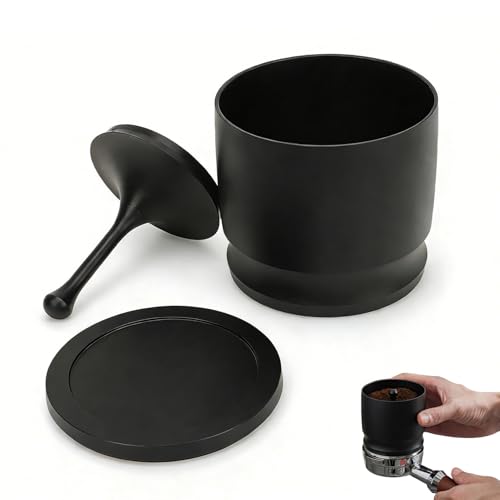
6. Polish The Puck With A Blind Shaker / Coffee Distributor

Upgrade your espresso routine with this advanced distribution tool!
In 2026, modern World Barista Championships have highlighted the immense power of shaking rather than just stirring. A blind shaker serves as a highly advanced coffee distributor tool that fundamentally upgrades your puck preparation routine.
By vigorously shaking the coffee inside an aluminum cup, you completely homogenize coffee grounds and eliminate static electricity simultaneously. This rapid homogenization significantly boosts extraction consistency, regularly increasing total extraction yields by 1-2% when compared to older spin-style wedge distributors.
What You Need
- Aluminum blind shaker cup (Metal is crucial to dissipate static electricity)
- Central pull-plug mechanism (Allows grounds to drop perfectly into the center of the basket)
- Snug lid (To prevent coffee dust from flying out during vigorous shaking)
- Basket matching diameter (The base must fit directly inside or over your specific 58mm or 54mm portafilter lip)
Routine Steps
- Grind your coffee beans directly into the closed blind shaker cup.
- Place the lid securely on top of the shaker.
- Shake vigorously up and down, then side to side for exactly 5 seconds to declump and mix the grounds.
- Remove the lid and seat the shaker directly onto the top of your portafilter basket.
- Pull the central plug straight up and out. Use the plug to gently tap the sides of the shaker so all grounds fall perfectly flat into the basket.
Pro-Tip: While spin-style distributors (wedge tools) make the top of the coffee bed look perfectly smooth, they actually compress the top half of the puck while leaving the bottom half loose. A blind shaker or deep WDT creates a truly homogenized puck from top to bottom, which is the only real way to prevent internal channeling.
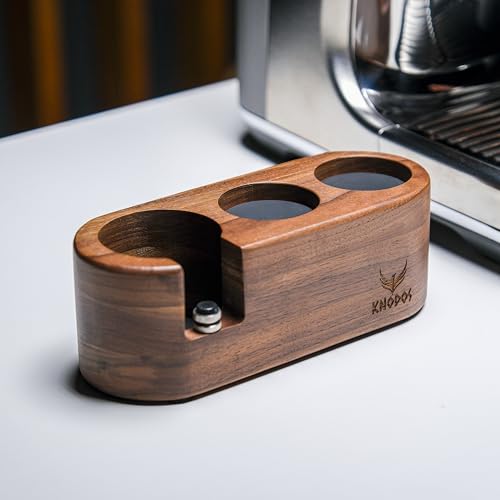
7. Organize Your Workflow With A Tamping Station

Keep your coffee bar beautifully organized. Pin this setup!
Even the most expensive precision tools fail if your foundation is fundamentally unstable. An espresso tamping station provides a rigid, ergonomic resting place for your portafilter. Attempting to tamp on a bare, slippery counter practically guarantees a crooked puck.
By securing your equipment in a heavy wood block or thick tamping mat, you streamline your barista workflow and protect delicate kitchen countertops. A dedicated portafilter stand physically supports the metal spouts, preventing wrist injuries over long-term use and completing your ultimate home setup.
What You Need
- Solid wood or heavy silicone base (Must not slide around on the counter when applying 30lbs of pressure)
- Fitted portafilter slot (Allows the portafilter to rest perfectly horizontally without wobbling)
- Accessory cutouts (Dedicated resting spots for your tamper, WDT tool, and puck screen)
- Knock box integration (Optional, but excellent for saving counter space)
Routine Steps
- Set up your tamping station directly next to your espresso grinder for a seamless workflow.
- Rest your portafilter horizontally into the dedicated station groove.
- Execute your WDT and funnel routines while the portafilter is stabilized by the block.
- Tamp directly downward. The station absorbs the pressure and keeps the basket perfectly flat, preventing edge channeling.
- Return all your espresso accessories to their designated cutouts to keep your coffee bar aesthetic clean and organized.
Pro-Tip: If you use a spouted portafilter rather than a bottomless one, never tamp directly on a hard countertop. The metal spouts will severely scratch your counters, and the uneven surface guarantees a crooked tamp. A dedicated tamping station with a spout-cutout is absolutely mandatory.
Key Takeaways: Your Quick Guide to Coffee Puck Accessories
Mastering your coffee puck accessories summary ensures you retain the most critical mechanical rules of extraction. The ultimate goal of this gear is to firmly fix espresso channeling by creating uniform resistance against pressurized water. When you streamline your workflow, you rapidly improve espresso extraction without relying on luck or guesswork. Review these key takeaways to solidify your understanding of precision puck preparation.
Key Takeaways:
- Declump thoroughly to prevent fast flow: Using a WDT tool with ultra-thin (0.3mm) needles breaks up dense grinder clumps, ensuring water flows evenly through the entire coffee bed rather than rushing down the sides.
- Level tamping is more important than heavy tamping: A calibrated, self-leveling tamper guarantees a perfectly flat surface, entirely eliminating the human error that causes severe channeling and sour shots.
- Keep your workspace clean with a funnel: A magnetic dosing funnel not only saves expensive coffee grounds from spilling but also allows you to WDT vigorously without making a mess on your counter.
- Puck screens diffuse harsh water pressure: By placing a 1.7mm stainless steel mesh screen over your tamped coffee, you prevent the machine’s shower screen from blasting holes directly into your puck.
- Always measure your input and output: You cannot dial in espresso by eye. Using a fast, 0.1g accuracy espresso scale is mandatory to hit the standard 1:2 brew ratio and stop your shot at the exact right moment.
- Consistency is the ultimate goal: The primary purpose of coffee puck accessories is to remove variables. Using these tools in the exact same order every day guarantees cafe-quality extraction yield regardless of your skill level.
FAQs About Coffee Puck Accessories
Troubleshooting home espresso setups often leads to complex technical questions about coffee puck accessories FAQs. Understanding exactly what causes espresso channeling requires addressing the specific physical interactions between your grinder, distribution tools, and the espresso machine itself. To help you resolve lingering fix espresso channeling queries and eliminate workflow confusion, we have compiled the most critical industry-standard answers regarding these specialized tools.
Do I really need a puck screen for espresso?
While not strictly mandatory, an espresso puck screen significantly improves water dispersion and keeps your espresso machine’s group head completely clean.
The metal mesh diffuses the harsh jets of water coming from the shower screen, ensuring the top layer of your coffee bed doesn’t get disturbed. Additionally, it completely prevents coffee grounds from being sucked back up into the machine’s internal solenoid valve, meaning you rarely have to backflush or scrub your group head.
What causes espresso channeling?
Espresso channeling is caused by uneven distribution of coffee grounds, a crooked tamp, or severe clumps in the coffee bed.
Pressurized water is lazy; it always seeks the path of least resistance. If one side of your coffee puck is less dense than the other, water will rush through that weak spot, rapidly over-extracting bitter flavors there while leaving the dense areas completely un-extracted (sour). Using proper distribution accessories eliminates these weak spots.
Is a WDT tool better than a spin distributor?
Yes, a WDT tool is vastly superior to a spin distributor because it homogenizes the entire depth of the coffee bed, whereas spin tools only groom the surface.
Spinning wedge levelers compress the top layer of coffee, making it look beautiful, but they leave dense clumps hidden at the bottom of the basket. A deep WDT technique breaks up clumps from the very bottom to the top, resulting in much higher and more even extraction yields.
What size tamper do I need for my espresso machine?
You must check your specific machine brand, but prosumer machines use 58mm baskets, while entry-level machines often use 54mm or 51mm baskets.
If you own a Breville Barista Express or Bambino, you need a 54mm tamper. If you own a high-end machine or use precision VST/IMS baskets, you should buy a 58.5mm precision tamper, which provides a much tighter fit than a standard 58mm tamper, preventing edge channeling.
Why is my espresso puck wet and muddy?
A wet, muddy puck is primarily caused by too much empty space (headspace) between the top of the coffee bed and the machine’s shower screen.
While muddy pucks don’t necessarily ruin the taste of the espresso, they are messy to knock out. You can easily fix a muddy puck by increasing your coffee dose by 1 gram, or by adding a thick 1.7mm espresso puck screen to fill the empty gap and absorb the excess water.
How hard should I tamp espresso?
You only need to tamp until you feel the coffee grounds stop compressing, which typically happens around 15 to 20 pounds of pressure.
You cannot “over-tamp” espresso; once the air pockets are pushed out, the coffee bed becomes a solid brick. Pressing harder past this point does absolutely nothing to change the extraction. The key is perfectly level tamping, not heavy tamping, which is why calibrated tampers are so highly recommended.
Can puck prep tools fix a bad coffee grinder?
No, puck prep tools can improve consistency, but they cannot fix an espresso grinder that produces wildly uneven particle sizes or cannot grind fine enough.
An espresso machine requires coffee grounds that are uniformly fine to create resistance. If your grinder produces a mix of boulders and dust, a WDT tool will help declump, but water will still channel through the boulders. Your grinder is always the most important tool in your setup.
How do I clean a reusable puck screen?
Rinse your puck screen with hot water immediately after every use, and soak it in espresso machine cleaning powder (like Cafiza) once a week.
Coffee oils and microscopic fines will slowly build up inside the intricate layers of the metal mesh. If left uncleaned, the screen will clog, heavily restricting water flow and making your shots pull completely unpredictably. A weekly 15-minute soak in Cafiza restores it to brand new.
What is the Weiss Distribution Technique?
The Weiss Distribution Technique (WDT) is the method of using ultra-thin needles to stir espresso grounds in the portafilter to eliminate clumps.
Invented by John Weiss in 2005, this technique has become the global standard for professional and home baristas alike. By breaking up the clumps created by the coffee grinder, the WDT method ensures the coffee bed density is perfectly uniform, drastically reducing the chance of channeling.
In what order do I use espresso puck prep accessories?
The correct workflow order is: scale (weigh dose), funnel, WDT tool, tamping station, tamper, then puck screen.
You must always distribute and declump before you tamp. Once you tamp the coffee into a compressed puck, you cannot stir or distribute it again without breaking the puck’s integrity. The screen is always placed on last, gently resting on top of the finalized tamped bed.
Final Thoughts on Coffee Puck Accessories
Mastering the art of espresso at home can feel incredibly frustrating, especially when you are doing everything right but still watching your shots spray out sideways. As of August 2026, the most important lesson you can learn as a home barista is that channeling is rarely a lack of talent—it is almost always a lack of proper mechanical distribution. You simply cannot fix microscopic clumps and uneven bed density with your bare hands.
By incorporating these specific accessories into your daily routine, you completely remove the guesswork and human error from your workflow. A WDT tool handles the internal density, a calibrated tamper ensures a mathematically flat surface, and a puck screen protects your hard work from harsh water pressure. Even World Barista Champions rely on these exact same tools to guarantee perfect extraction under pressure. Together, these tools transform an unpredictable, messy process into a smooth, satisfying ritual.
Remember, consistency is the true secret to cafe-quality coffee. When your puck preparation is identical every single time, you can finally focus entirely on the fun part: tasting your coffee, adjusting your grind size, and dialing in the perfect flavor profile. Which puck prep tool are you going to upgrade first to rescue your morning espresso?
Last update on 2026-08-27 / Affiliate links / Images from Amazon Product Advertising API
