
As an Amazon Associate CoffeeXplore.com earns from qualifying purchases.
How Does A Burr Grinder Work Complete Coffee Extraction Guide
Ever wondered exactly how does burr grinder work to transform roasted beans into café-quality espresso? Many home coffee enthusiasts struggle with sour or bitter brews caused by uneven blade chopping. Mastering this comminution mechanism is your first step toward perfect daily extraction.
A burr grinder works by crushing whole coffee beans between two revolving abrasive surfaces (burrs). One burr remains stationary while the motor spins the other. As beans enter the gap, large cutting flutes break them down progressively until they pass through a precisely set distance, resulting in uniformly ground coffee.
Based on extensive laser diffraction granulometry and peer-reviewed coffee comminution studies, this mechanical breakdown reveals the physics behind uniform particle size distribution. You will discover exactly how flat and conical burr geometries manipulate fluid dynamics to maximize extraction clarity for your daily brew.
Key Facts
- High-Volume Durability: Industry analysis reveals that high-quality hardened stainless steel burrs typically process 500 to 1,000 pounds of coffee before dulling.
- Precision Uniformity: Flat burrs rely on motor RPM and centrifugal force to expel grounds, creating a highly uniform, unimodal particle distribution ideal for modern espresso.
- Blade Grinder Flaws: Research indicates that blade grinders randomly chop beans into uneven boulders and dust, leading to both under-extraction (sourness) and over-extraction (bitterness) simultaneously.
- Static Elimination: Studies show that triboelectric static charging (which causes messy retention) is effectively neutralized by the Ross Droplet Technique (RDT), which involves spritzing beans with one drop of water.
- Thermal Dynamics: Conical burrs rely on gravity to pull beans downward, allowing them to operate at significantly lower RPMs and generate less frictional heat than high-speed flat burrs.
Contents
show
How Does A Burr Grinder Work?
A burr grinder works by crushing whole coffee beans between two revolving abrasive surfaces (burrs). One burr remains stationary while the motor spins the other. As beans enter the gap, large cutting flutes break them down progressively until they pass through a precisely set distance, resulting in uniformly ground coffee.
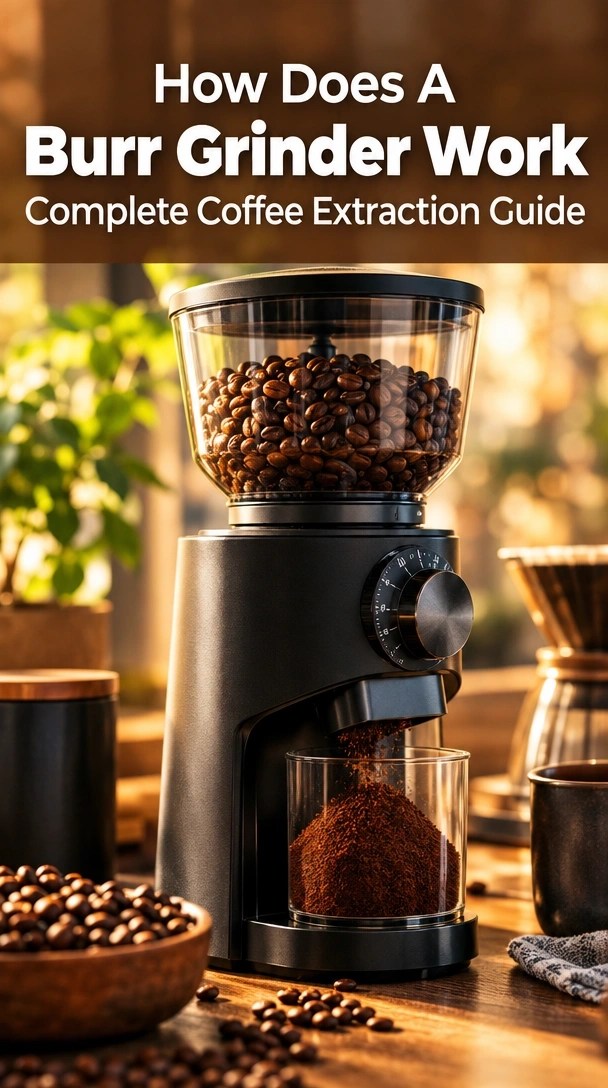
At its core, a burr grinder relies on a dual-component mechanism to execute precise coffee comminution (the mechanical process of reducing solid materials to a smaller, uniform size). An electric motor drives a rotating burr via a drive shaft, while a stationary burr remains fixed in place. You can think of the grinding chamber like a mechanical funnel lined with teeth. Whole beans feed in through the top, where aggressive pre-breaker flutes shatter them into large chunks. These chunks are then pushed outward or downward into increasingly smaller micro-teeth.
This progressive shearing process is fundamentally different from a blender. A burr grinder physically forces the coffee through a micrometric gap. The beans cannot escape the grinding chamber until they are small enough to pass between the tightest point of the opposing parallel flat discs or the inner cone and outer ring. This mechanical restriction ensures a uniform particle size distribution.
Uniformity directly dictates your cup quality. When hot water hits ground coffee, it extracts solubles at a rate determined by the particle’s surface area. If your grinder produces identical particles, the water extracts flavor evenly. This structural consistency prevents channeled extraction in espresso pucks and ensures a balanced taste profile without harsh acidity or lingering bitterness.
How Does The Burr Adjustment Mechanism Control Micron Particle Size?
Burr grinders control grind size by adjusting the physical distance between the stationary and rotating burrs. Moving the burrs closer together produces a finer espresso grind, while widening the gap produces a coarse grind for French press or cold brew.
The distance between the burrs is regulated by an adjustment mechanism, typically an aluminum grind adjustment collar. Think of this collar like a heavy-duty threaded screw. Turning the dial threads the upper burr carrier up or down. A tiny micro-adjustment on the dial physically moves the stator (the stationary burr) fractions of a millimeter.
Grinders typically feature one of two adjustment styles:
* Stepped Adjustment: Uses preset notches or clicks. This is user-friendly for beginners but limits your ability to make microscopic changes when dialing in espresso grind.
* Stepless Adjustment: Uses an infinite worm drive or smooth threading. This provides micrometric grind adjustment with no preset stops, favored by professionals for exact extraction control.
Pro Tip: Always adjust your burr grinder to a finer setting while the motor is actively running. Forcing the burrs closer together while the machine is off can trap hard coffee bean fragments in the burr cutting flutes and serrations, jamming the motor or stripping the alignment threads.
What Are The Core Components Of A Burr Grinder?
The anatomy of a burr grinder consists of three main systems:
1. The Hopper: Feeds whole beans via gravity into the grinding chamber.
2. The Motor and Burrs: A high-torque motor drives a rotating burr against a stationary burr to shear the coffee.
3. The Exit Chute: Uses centrifugal force or gravity to expel uniformly ground coffee into a catch cup or portafilter.
Understanding the internal electrical and mechanical systems helps you evaluate build quality. The bean hopper acts as the gravity-fed staging area. Many premium models feature a magnetic anti-popcorning hopper insert. This prevents beans from bouncing away from the pre-breaker bean feeding teeth, ensuring a continuous, even feed rate into the grinding chamber.
The true engine of the machine is the motor drive block. High-quality grinders utilize a low RPM gear reduction motor. This design provides massive torque while keeping the rotational speed RPM deliberately low. High torque is necessary because light roast coffee beans are exceptionally dense and hard; a weak motor stalls under light roast bean torque. Meanwhile, the gear reduction prevents the burrs from spinning too fast. High-speed spinning generates excessive heat, which causes premature coffee bean degassing and thermal degradation of volatile aromatic compounds.
After the beans are crushed, they enter the grind chamber retention cavity and are pushed out through the exit chute. The design of this chute is critical. Poorly designed horizontal chutes suffer from high retention, where stale coffee gets trapped inside the machine. Modern single-dose grinders utilize steep vertical chutes to minimize this dead space volume, ensuring what you put into the grinder is exactly what comes out.
What Is The Difference Between Ceramic And Stainless Steel Burrs?
Stainless steel burrs are precision-machined for sharper cutting edges, producing a highly uniform grind ideal for pour-over and espresso. Ceramic burrs are cast, making them slightly duller but highly resistant to dulling over time.
A common myth suggests ceramic is universally superior because it “does not heat up.” However, the thermal conductivity of burr materials is only part of the equation. Hardened stainless steel burrs measure very high on the Rockwell hardness scale rating (HRC). This allows engineers to use precision CNC machining tolerances to create exceptionally sharp cutting flutes. Sharper edges shear the bean cleanly, producing fewer micro-fines.
Ceramic grinding burrs are molded and baked, which inherently leaves their cutting edges slightly rounded. While ceramic retains less frictional heat and resists long-term wear, the duller edges tend to crush rather than slice the beans, generating slightly more dust. For high-clarity specialty coffee, machined steel or titanium carbon nitride coated burrs are the industry standard.
| Feature/Aspect | Hardened Stainless Steel Burrs | Ceramic Burrs | Titanium Coated (TiN) Burrs |
|---|---|---|---|
| Manufacturing Process | CNC precision machined | Molded/Cast | Machined steel + PVD coating |
| Edge Sharpness | Exceptionally sharp | Slightly rounded/dull | Exceptionally sharp |
| Thermal Conductivity | High (Heats up faster) | Low (Retains less heat) | Moderate |
| Durability/Lifespan | ~500-1000 lbs of coffee | ~750-1500 lbs (Brittle if dropped) | ~2000+ lbs of coffee |
| Best Used For | High-clarity pour-over, espresso | Traditional espresso, hand grinders | Commercial environments |
Flat vs Conical Burrs: What Are The Key Differences?
The main difference between flat and conical burrs is how they distribute particle sizes. Flat burrs use two parallel discs that rely on motor speed and centrifugal force to expel grounds, creating a highly uniform (unimodal) grind for high flavor clarity. Conical burrs use a cone inside a ring, using gravity to pull beans through, producing a bimodal grind with more fines that creates a thicker, heavier-bodied coffee.
The debate between flat burrs vs conical burrs dictates the fundamental taste profile of your coffee. A flat burr grinder utilizes opposing parallel flat discs. Because the beans are fed horizontally, the grinder requires high rotational velocity. Centrifugal force flings grounds through the teeth and out the sides. This violent, high-speed exit path means the coffee particles spend less time in the cutting zone, resulting in an incredibly uniform grind with distinct, separated flavor notes.
Conversely, a conical burr grinder uses an inner cone and outer ring. This architecture is a gravity-fed grinding chamber. The beans fall straight down through a long vertical cutting path. As the beans travel downward, they are crushed repeatedly at a lower RPM. This longer path and crushing action naturally produce a mix of main particles and microscopic coffee dust (fines). This specific blend creates a heavy, syrupy body perfect for traditional milk-based espresso drinks.
| Feature/Aspect | Flat Burr Grinders | Conical Burr Grinders |
|---|---|---|
| Burr Geometry | Two parallel opposing discs | Inner cone and outer serrated ring |
| Bean Feed Mechanism | Motor RPM / Centrifugal force | Gravity-fed |
| Particle Distribution | Unimodal (highly uniform) | Bimodal (main particles + fines) |
| Taste Profile Focus | Flavor clarity, distinct tasting notes | Heavy body, syrupy texture, blended flavors |
| RPM & Heat Generation | High RPM (Generates more frictional heat) | Low RPM (Generates less heat) |
| Ideal Use Case | Light roasts, modern espresso, specialty pour-over | Dark roasts, traditional espresso, French press |

What Is A Bimodal vs Unimodal Particle Distribution?
A unimodal particle distribution means the burr grinder produced coffee grounds of almost identical sizes, resulting in high flavor clarity. A bimodal distribution means the grinder produced two distinct sizes—main particles and micro-fines—which restricts water flow to create thicker crema and heavier body in espresso.
Industry experts utilize a laser diffraction particle size analyzer to graph ground coffee. When they plot the size of the grounds on a chart, a flat burr grinder produces a single, tight bell curve. This is a unimodal fines-reduced distribution. Imagine evenly diced potatoes; they all cook at the exact same rate. In coffee, this uniform surface area to volume extraction ratio means the water extracts all flavors simultaneously, yielding a bright, clear cup.
A conical burr produces a bimodal particle distribution curve. The graph shows two peaks: one for the main coffee grounds, and a smaller peak for microscopic coffee dust. These micro-fines extract instantly, adding bitter complexity and thick texture. In espresso, micro-fines migration in espresso pucks physically clogs the bottom of the filter basket, building the high percolation flow resistance mechanics necessary to generate thick crema.
Why Is A Burr Grinder Better Than A Blade Grinder?
A burr grinder is superior to a blade grinder because it guarantees a uniform particle size. While a blade grinder randomly chops beans into a mix of huge chunks and fine dust, a burr grinder acts like a mill, passing beans through a precise gap. This uniformity ensures the water extracts flavor evenly, preventing your coffee from tasting simultaneously bitter and sour.
A blade coffee grinder uses high-velocity choppers that act like an airplane propeller. It relies entirely on blunt force impact and the length of time you hold the button down. The result is chaotic. Some beans dodge the blade and remain as massive boulders, while others are repeatedly pulverized into fine dust. When you brew this uneven mixture, the water rushes past the boulders (under-extraction sourness) and over-cooks the dust (over-extraction bitterness).
A burr grinder solves this chemical extraction flaw through precision mechanical clearance. The distance between the burrs physically blocks large boulders from escaping. The beans extract at an even rate because the grounds share an identical surface area. Fluid dynamics through a compacted coffee puck require even resistance; blade grinds cause aggressive channeling, whereas burr grinds allow smooth, laminar water flow for a sweet and balanced taste.
| Feature | Blade Grinder | Burr Grinder |
|---|---|---|
| Mechanism | High-velocity spinning propeller | Precision crushing between two gears |
| Grind Consistency | Highly uneven (boulders and dust) | Highly uniform (controlled by gap size) |
| Heat Generation | Very high (burns coffee aromatics) | Low to Moderate (preserves oils) |
| Extraction Result | Channeling, bitter and sour taste | Even extraction, sweet and balanced taste |
| Adjustability | Based purely on timing (guesswork) | Micrometric dial settings (precise) |
What Common Problems Occur With Burr Grinders And How Do You Fix Them?
The most common burr grinder problems and their fixes include:
* Static cling (Messy grounds): Spritz beans with one drop of water before grinding (Ross Droplet Technique) to eliminate static.
* Clogged burrs: Stop using overly oily dark roasts, and run specialized grinder cleaning tablets through the machine.
* Inconsistent grind size: The burrs may be dull (replace after 500lbs) or the burr carrier is misaligned and needs recalibration.
Static electricity is the most frustrating issue for home baristas, causing grounds to spray everywhere and cling to the chute. This is caused by triboelectric static charging of coffee particles rubbing against the burrs. To fix grinder static ground retention, implement the Ross Droplet Technique (RDT). Simply wet the handle of a spoon or use a small atomizer to add a single drop of water to your whole beans before pouring them into the hopper. This tiny amount of moisture instantly dissipates the static charge, leaving your counter completely clean.
Another common problem is a clogged burr chamber. This occurs almost exclusively when users grind heavily roasted, oily beans. Dark roast oils act like glue, causing grounds to pack into the cutting teeth and the exit chute retention cavity. Over time, this restricts flow entirely. To resolve this, you must stop using glistening, oily beans and run food-safe grinder cleaning tablets to absorb the oxidized oils from the burr teeth.
How Often Should You Clean A Burr Coffee Grinder?
To properly clean a burr coffee grinder:
1. Daily: Tap the grinder or use a bellows to clear the exit chute of retained grounds.
2. Weekly: Unplug the grinder and use a stiff brush to sweep out the burr chamber and chute.
3. Monthly: Grind 15 grams of specialized grinder cleaning tablets (do not use raw rice) to absorb oxidized oils from the burr flutes.
Regular maintenance preserves both your equipment lifespan and your coffee flavor profile. Stale coffee grounds trapped in the retention cavity oxidize rapidly, passing rancid, bitter flavors into your fresh daily brew. Disassembling the grinding chamber every four to six weeks is mandatory for peak performance.
Pro Tip: Never use raw white rice to clean your grinder. Uncooked rice is significantly harder than roasted coffee beans. Forcing rice through your burr set can shatter ceramic grinding burrs, snap the drive shaft, or strip the gear reduction motor. Always use formulated, food-safe starch cleaning tablets designed specifically to crumble under pressure while absorbing oils.
FAQs About How Does Burr Grinder Work
How does a manual hand burr grinder work without electricity?
A manual hand burr grinder works using a hand crank attached to a central drive shaft that spins an internal conical burr against a stationary outer ring burr. Because it uses human torque instead of a high-speed motor, manual grinders operate at very low RPMs, which produces virtually no frictional heat, preserving delicate coffee aromatics while delivering highly uniform particle distributions.
Can a coffee burr grinder be used for spices?
Yes, but it is highly discouraged unless you dedicate the grinder exclusively to spices. Spices contain dense, pungent oils that will permanently impregnate the steel or ceramic burrs and the plastic internal chutes. If you grind cumin or cloves in your coffee burr grinder, every batch of coffee you brew afterward will taste like those spices, even after a deep cleaning.
How long do steel coffee burrs last before going dull?
High-quality hardened steel coffee burrs typically last for 500 to 1,000 pounds of coffee before they go dull. For a home user brewing one 250-gram bag of coffee per week, a set of steel burrs will last between 15 and 30 years. You will know it is time to replace them when you have to constantly grind finer to get the same extraction, or if grinding takes twice as long.
How does burr size impact grinding speed and consistency?
Larger burrs (e.g., 64mm to 83mm) grind coffee much faster and with greater uniformity because they have a larger cutting surface area and a longer feed path. A larger diameter allows the beans to be sheared more gradually across a wider surface, which reduces the production of micro-fines and minimizes the frictional heat that can damage coffee oils.
Does motor RPM affect coffee grind particle uniformity?
Yes, motor RPM significantly affects grind uniformity and the creation of coffee fines. Higher RPM motors tend to shatter beans more violently, which can create a higher volume of micro-fines and static electricity. Lower RPM motors (or hand grinders) crush the beans more gently, resulting in a tighter, more uniform particle distribution and less thermal degradation.
Why do flat burrs produce more heat than conical burrs?
Flat burrs produce more heat because they require high-RPM motors to generate the centrifugal force necessary to push the coffee grounds horizontally out of the burr chamber. This high-speed friction heats the metal. Conical burrs rely on gravity to pull the beans downward, allowing them to operate at much lower RPMs, generating significantly less heat.
What causes static retention in burr coffee grinders?
Static retention is caused by the triboelectric effect, where coffee particles create friction against the metal burrs and plastic chutes, building up an electrical charge. This causes the grounds to repel each other and stick to the exit chute. This is most common in dry, winter climates or when grinding very light roast coffees at high RPMs.
How do you align flat burrs for optimal precision?
Flat burrs are aligned using the “marker test,” where you color the outer edge of the burrs with a dry-erase marker, run the grinder until the burrs barely touch, and check where the ink rubs off. If the ink rubs off unevenly, you place microscopic shims (like aluminum foil) under the low spots of the burr carrier until the burrs are perfectly parallel, ensuring maximum grind uniformity.
What is retention and why does a burr grinder retain coffee?
Retention is the amount of ground coffee that gets trapped inside the burr chamber and exit chute after the motor stops. Grinders retain coffee because of static cling, dead space inside the grinding chamber, and the horizontal design of the exit chute. High retention is bad because trapped grounds go stale and mix with your fresh coffee the next time you brew.
Can you sharpen dull coffee grinder burrs?
No, you cannot effectively sharpen coffee grinder burrs at home. The cutting flutes and micro-teeth on a burr are precision-machined by CNC equipment to exact micrometer tolerances. Attempting to sharpen them with files or abrasives will ruin the geometry, destroying the grinder’s ability to produce uniform particles. Once dull, burrs must be entirely replaced.
Key Takeaways: Burr Grinder Mechanics Summary
- The Mechanism is Crushing, Not Chopping: A burr grinder works by passing beans through a precise gap between a stationary burr and a rotating burr, progressively shearing them into uniform particles, unlike a blade grinder which randomly chops.
- Particle Uniformity Dictates Flavor: The primary purpose of a burr grinder is to create grounds of the exact same size. Boulders cause sourness, while fines cause bitterness; uniform grinds allow for sweet, balanced extraction.
- Flat vs. Conical Yields Different Tastes: Flat burrs use centrifugal force to create a unimodal grind (high flavor clarity), while conical burrs use gravity to create a bimodal grind (heavier body and texture).
- Gap Distance Controls the Grind: You adjust a burr grinder by physically moving the burrs closer together (for fine espresso) or further apart (for coarse French press) using a micrometric adjustment collar.
- Maintenance is Non-Negotiable: To keep a burr grinder functioning optimally, you must clean it regularly with a brush and specialized tablets to prevent rancid oils and static retention from ruining your coffee.
Final Thoughts on How Burr Grinders Work
Understanding how a burr grinder works is the most critical step in mastering coffee brewing, as uniform particle distribution is the only way to achieve balanced, even extraction. A premium espresso machine cannot fix a bad grind; the physics of flavor extraction rely entirely on the mechanical precision of your burr set.
By moving away from chaotic blade choppers and investing in a true comminution mill, you take total control over your morning cup. Your decision moving forward simply depends on your taste preferences. If you crave intense, heavy-bodied traditional espresso, a conical burr grinder is your best asset. If you prefer bright, high-clarity modern roasts where you can identify specific fruit notes, a flat burr grinder will serve you perfectly.
As of September 2026, the specialty coffee industry unanimously agrees: the grinder is far more important than the brewer. Dialing in espresso grind becomes an exact science rather than a guessing game when you trust precision machinery. Commit to routine maintenance, utilize the RDT static fix, and allow your burr grinder to unlock the full potential hidden inside your coffee beans. Which burr geometry will you try first?
Last update on 2026-09-30 / Affiliate links / Images from Amazon Product Advertising API
